Trust Carbon Infrastructure has been accepted into the Halcyon Global Climate Fellowship 2026, the flagship climate cohort of Halcyon, one of the most consequential impact-driven accelerators operating in the United States. The recognition places Trust Carbon among a small selection of ventures that Halcyon considers load-bearing for the future of climate adaptation and resilience. The selection adds Halcyon to the roster of institutions backing the platform, alongside the DPI Challenge win supported by the Gates Foundation, the Boston Consulting Group and the Japan International Cooperation Agency.
Key Takeaways
- A selective, impact-first program. Halcyon has supported more than 650 founders since 2014. It is not a pitch contest and not an equity play. It is a structured six-month acceleration container for ventures already working on problems that matter.
- Zero equity, zero fees, zero shortcuts. Halcyon takes no equity, charges no fees and issues no warrants. Its incentives are aligned with long-term venture outcomes, not short-term portfolio marks.
- A decade of proven impact. In 2023 alone Halcyon supported 75 ventures and 101 fellows from 26 countries, with fellows raising significant follow-on capital and improving tens of thousands of lives.
- Climate as architecture, not slogan. The 2026 cohort focuses on climate adaptation and resilience, where capital gaps are widest and verification infrastructure is most directly consequential.
- Another institution backing the thesis. Serious climate institutions now read Trust Carbon's work as infrastructure, not as another optional layer on an already crowded market.
Why this recognition matters: Halcyon selects ventures that can move the rest of the climate ecosystem forward. A verification layer that an entire cohort of adaptation ventures could, in principle, plug into is exactly the kind of position Halcyon is designed to identify and amplify.
About Halcyon: A Decade of Impact
Founded in 2014 in Washington, D.C., Halcyon began as an incubator for early-stage social entrepreneurs and has evolved into a layered ecosystem supporting impact-driven founders across climate, health and equity technology. Its name comes from a Greek myth: the halcyon bird, granted two weeks of calm seas to raise its young. The institution built its programs around the same idea. Give founders a container of focused time, professional support and community, and watch what becomes possible.
In its first decade, Halcyon grew into one of the most respected impact accelerators in the United States, operating out of the historic Halcyon House in Georgetown before expanding its programming into a portfolio that now includes residencies, virtual fellowships, issue-driven intensives and a post-program alumni network. In 2021, the organization made a deliberate shift toward backing impact-driven businesses beyond the idea stage, adding financing vehicles to support ventures with scalable growth potential. In 2024, Halcyon reaffirmed and formalized its climate commitment with the launch of three dedicated verticals: Climate, Health and EquityTech.
By late 2025, more than 650 founders had passed through Halcyon's programming. In 2023 alone, the organization supported 75 ventures and 101 fellows representing 26 countries. The 2023 annual report documents a portfolio generating material employment, revenue and demonstrable lives improved in the communities the ventures serve. The survival and impact rates of Halcyon alumni compare favorably to the broader accelerator landscape, a fact the organization is deliberate about measuring and publishing.
The Global Climate Fellowship: Structure and Philosophy
The Halcyon Global Climate Fellowship 2026 is a hybrid six-month program designed for founders working at the intersection of climate and the built, natural and financial systems that climate change is stressing. Two in-person residency weeks, one in Washington, D.C. and one in Los Angeles, bracket a block of structured virtual programming that runs from spring to late summer. Fellows move through a deliberately designed sequence of masterclasses, peer case consultations, advisor office hours, pitch practice and individual goal check-ins with the program team.
What makes the program distinct is not any single session. It is the integration. Halcyon is one of the few accelerators in the United States that designs its curriculum around the three interlocking pillars every climate venture has to solve at once: leadership, investment readiness and product-market fit. Most accelerators pick one and lean on it. Halcyon refuses the tradeoff. Its fellows come out of the program stronger on all three at the same time, which is why the alumni track record is what it is.
The cohort structure matters as much as the curriculum. Halcyon selects a small number of ventures and deliberately builds a group that learns from each other. Peer case consultations, in which one fellow presents a real business challenge and the cohort works the problem collaboratively, are treated as seriously as any masterclass. The resulting network of fellows, advisors, staff and partners is arguably the most durable thing Halcyon produces.
Eligible sectors for the Climate Fellowship are deliberately broad enough to cover the actual shape of the climate challenge: renewable and resilient energy systems, adaptive infrastructure and green building, climate intelligence and early-warning systems, climate-smart agriculture and food systems, WaterTech and water security, blue economy and coastal resilience, and financial resilience to climate shocks. Across these verticals, Halcyon looks for ventures whose technology or model is structurally relevant to how communities and ecosystems will have to adapt over the next twenty years.
Past Cohorts and the Alumni Signal
The 2026 cohort inherits the reputation built by the ventures that came before it. Halcyon's climate and adaptation alumni include ventures working on electronic waste recovery in Latin America, agricultural technology for smallholder farmers across Africa, community resilience infrastructure in the United States, and a long list of ventures operating at the intersection of climate data, land use and financial flows.
Halcyon has documented that roughly ninety percent of ventures from its regional climate fellowships remain active years after graduation, having collectively raised millions in follow-on funding, generated millions in revenue, created hundreds of jobs in the DMV region, and reported tens of thousands of lives positively impacted. Those numbers are the quiet case for the program. They explain why founders who have been through it rarely talk about the credentials and almost always talk about the container.
Why This Recognition Matters for the Carbon Market
Trust Carbon Infrastructure is building the verification layer of the voluntary carbon market. The thesis is architectural: a carbon credit is only as credible as the data point from which it was derived, and today most credits are derived from data that was never cryptographically verified at the point of capture.
This work is adjacent to almost every venture Halcyon supports in climate. A climate-smart agriculture venture that cannot credibly prove carbon sequestration outcomes cannot monetize its work at scale. A blue economy venture depending on carbon finance for coastal resilience cannot close institutional capital without defensible verification. A resilient infrastructure venture selling into public procurement needs a trust layer that auditors, insurers and regulators can actually trust.
Trust Carbon is the infrastructure that makes all of that financeable. The Halcyon selection is a validation of exactly that framing. It follows the DPI Challenge recognition with its one-hundred-thousand-dollar prize backed by the Gates Foundation, Boston Consulting Group and JICA. The institutions asking the hardest questions about what the voluntary carbon market actually needs keep arriving at the same answer: infrastructure. Trust Carbon is building exactly that.
What the Program Unlocks for Trust Carbon
The fellowship runs alongside Trust Carbon's existing product roadmap. It does not change the build. It compresses the distance between the build and the institutions, buyers, advisors and regulators that the platform ultimately has to serve.
Trust Carbon's commercial surface is enterprise carbon project developers, voluntary market standard bodies, insurers and auditors who carry liability for verification quality, and, increasingly, national and subnational governments building Article 6 reporting infrastructure under the Paris Agreement. Several of those audiences are structurally easier to reach from Washington, D.C. and Los Angeles than from anywhere else. The Halcyon cohort, the advisor network and the alumni community compound those adjacencies.
Equally important is what the fellowship does for the founder individually. The Halcyon curriculum is explicit about the fact that climate ventures fail most often not for lack of technology or capital but for lack of leadership bandwidth to execute both at once. A founder who exits the program with a clearer decision-making posture, a stronger advisor bench and a refined capital strategy is a founder who can run the company longer and better. Trust Carbon is in a build phase that will determine how the voluntary carbon market evolves over the next five years. The fellowship is a deliberate investment in the leadership bandwidth required to run that build correctly.
A Statement from the Founder
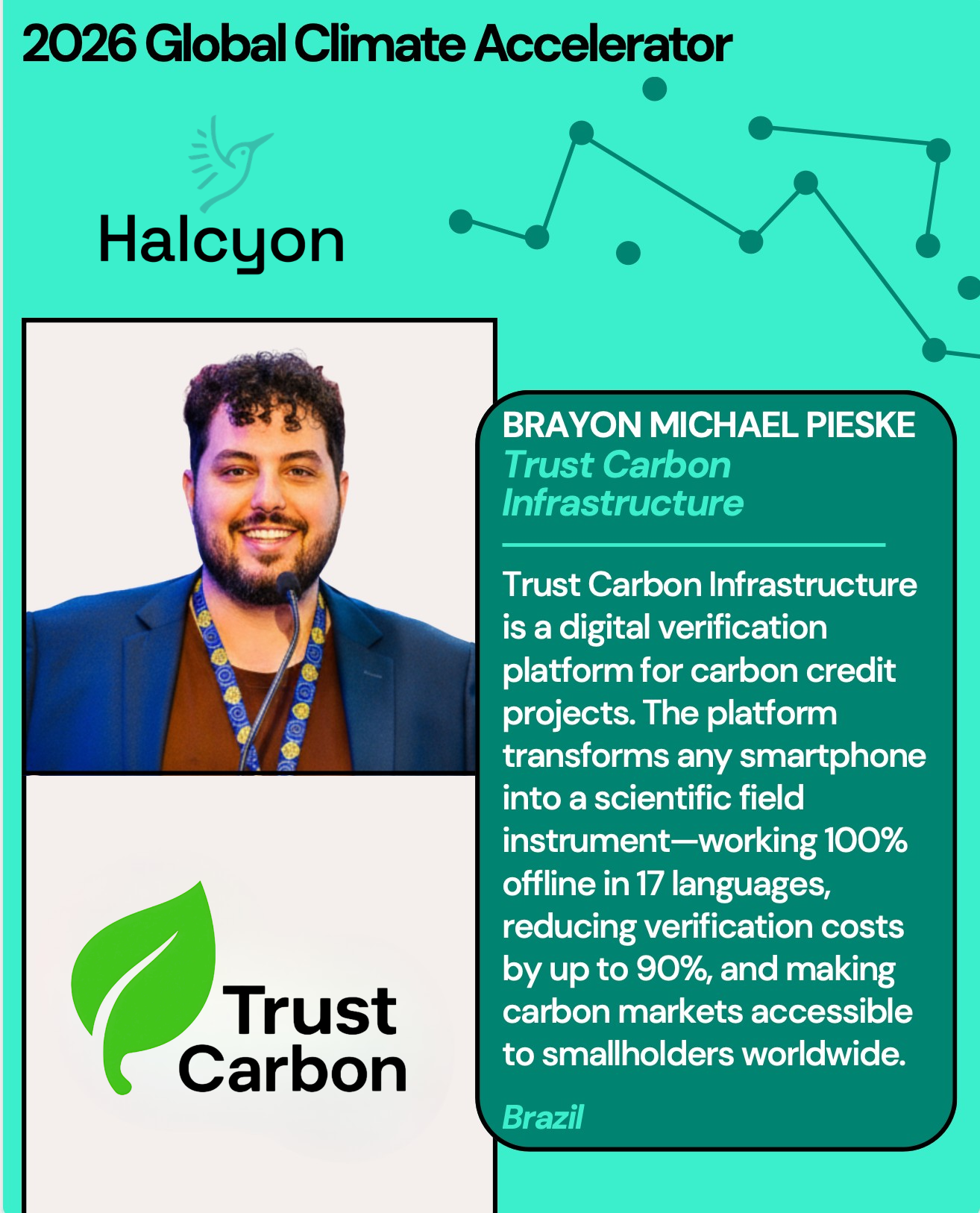
Halcyon is the rare institution whose model actually matches its mission. No equity. No fees. No theater. The program takes a cohort of founders working on problems that matter, and it builds a six-month container in which the work accelerates for real reasons. Trust Carbon is building the infrastructure the voluntary carbon market needed ten years ago and has finally become willing to demand. Having Halcyon on the roster of institutions that chose to back that work is the kind of validation that compounds. We intend to spend every hour of the fellowship using it.
The Infrastructure Trust Carbon Builds
Trust Carbon Infrastructure is the integrity layer of the voluntary carbon market. It is not a registry. It is not a certifier. It is not a consultancy. It connects the entire value chain through a single infrastructure, organized around four pillars. Each pillar serves a different audience and covers a different step of the carbon project lifecycle.
Developers create verified project areas, receive AI-powered methodology recommendations tailored to their land type and certification goal, select the best fit, invite their field team and local community, and start collecting in minutes. The entire setup is automated.
Transforms any smartphone into a scientific data collection instrument. Works 100% offline in 17 languages. Advanced AI analyzes each collected parameter in real time, flagging inconsistencies before data ever leaves the field.
Certifiers see all active projects built under their methodologies in one place. They can create new standards, adapt existing ones, and publish them directly into the infrastructure, fully automated, without any manual configuration.
Every verified project is publicly accessible through an immersive, interactive interface. Investors and carbon credit buyers explore real field data and verification records in full transparency, seeing exactly what was collected, where, and when, before committing capital.
Where to Go Next
This article is a recognition announcement. If you want to see the Trust Carbon Infrastructure platform itself, including the four pillars in more detail, how the methodology engine works, and what is available today for project developers, certifiers, field teams and investors, head to the Trust Carbon homepage.
Learn More About Trust Carbon Infrastructure
Visit the Trust Carbon homepage to see how Project Setup, Field Collection, Certification Bodies and Investor Access connect through one infrastructure.
Learn More on the Homepage